
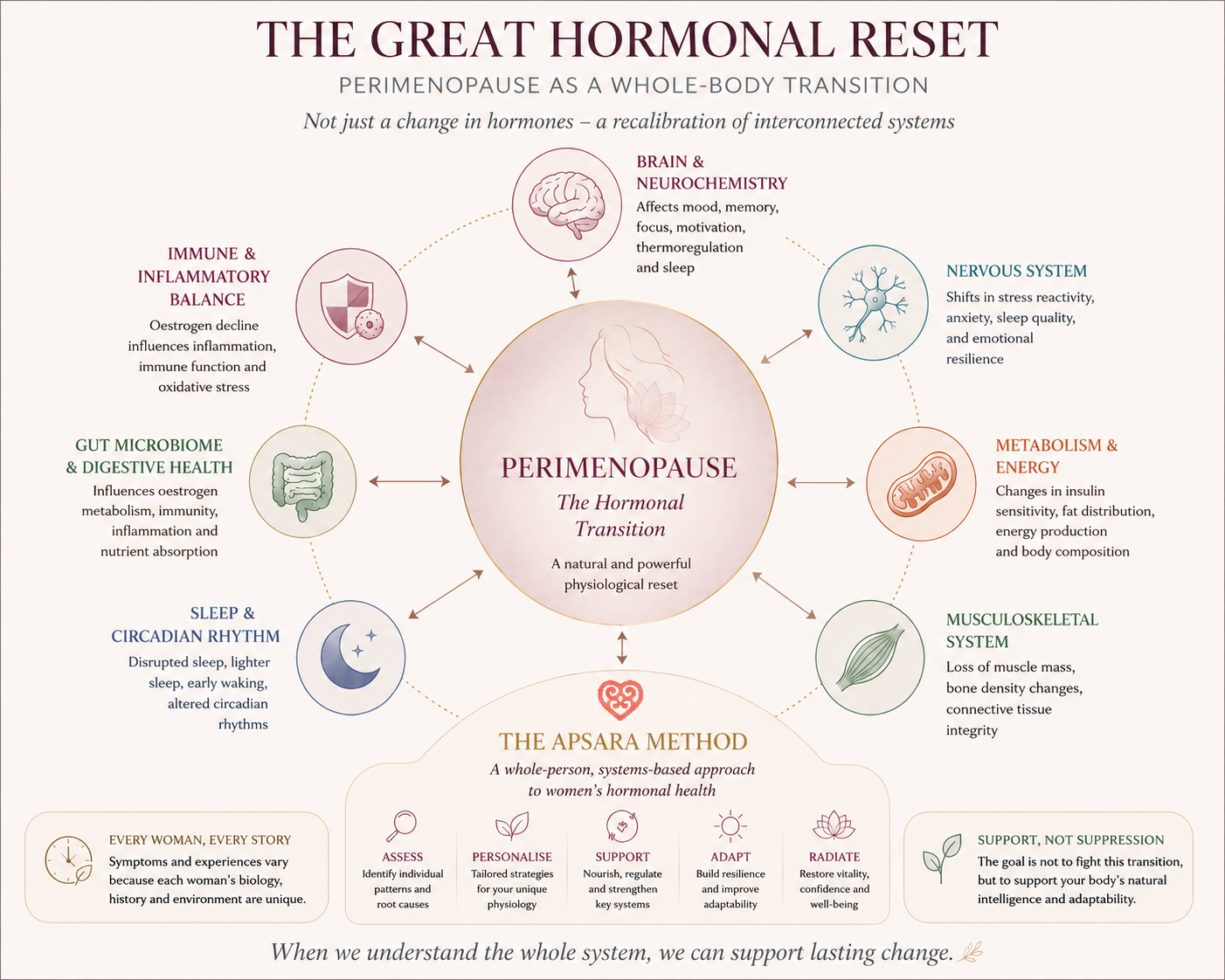
Understanding why perimenopause is far more than falling hormones and how physiology changes the conversation
For generations, women have entered perimenopause with very little understanding of what is happening inside their bodies. Even today, the explanation is often surprisingly simple: hormones change, oestrogen falls, and symptoms begin.
Whilst that is true, it tells only part of the story.
Perimenopause is not simply the beginning of menopause, nor is it just about declining hormones. It is a natural transition during which the entire body begins to adjust to a new hormonal environment. Although the ovaries begin the process, the brain, immune system, muscles, metabolism, body fat and even the gut all respond to these changes [1–3].
This helps explain why the symptoms can seem so different from one woman to another. Hot flushes, anxiety, disturbed sleep, brain fog, changes in body shape and reduced resilience to stress may appear unrelated, yet they are often connected by the same underlying physiological changes.
It also explains why every woman experiences perimenopause differently. Some notice only mild symptoms, whilst others find that almost every aspect of daily life is affected. Hormone levels are only one part of the picture. Sleep, nutrition, physical activity, inflammation, metabolic health, stress and the gut microbiome all influence how well the body copes with this transition [4–7].
Over the years, I have come to think of perimenopause as a kind of physiological stress test. It rarely creates entirely new problems. More often, it highlights areas where the body has been quietly compensating for years.
Instead of asking only, “Which symptom should I treat?”, it can be far more helpful to ask:
What is my body trying to tell me?
Answering that question often explains why symptoms may begin years before periods become irregular, why no two women experience this transition in the same way, and why supporting the whole body is often more effective than focusing on hormones alone.
The Great Hormonal Reset
One of the biggest misconceptions about perimenopause is that it begins when oestrogen starts to fall. In reality, hormones rarely decline in a smooth and predictable way. Instead, they begin to fluctuate, sometimes rising unexpectedly before falling again [1].
This is an important difference.
For decades, the brain and ovaries have worked together in a carefully coordinated rhythm. Every month, oestrogen and progesterone rise and fall in a predictable pattern. This rhythm influences far more than fertility. It also affects mood, sleep, memory, body temperature, energy levels, immune function and metabolism [8–10].
As the ovaries gradually age, that rhythm becomes less reliable. Ovulation occurs less consistently, progesterone production starts to decline, and hormonal signals become increasingly unpredictable. For many women, these fluctuations are what trigger the earliest symptoms.
The brain is particularly sensitive to these hormonal changes. Oestrogen and progesterone influence important brain chemicals such as serotonin, dopamine, GABA and noradrenaline, all of which help regulate mood, sleep, concentration and body temperature [8–12].
When hormone levels fluctuate from one month to the next, the brain has to keep adapting. This helps explain why anxiety, poor sleep, emotional sensitivity or difficulty concentrating often appear years before menopause itself.
This is why I see perimenopause as the body’s great hormonal reset.
Rather than simply producing less hormone, the body is learning to function with a completely new hormonal pattern. The ovaries may begin this transition, but the brain, muscles, immune system, metabolism, body fat and gut all have to adapt as well.
One of the earliest features of perimenopause is therefore not simply lower hormone levels, but the loss of hormonal stability.
The First Hormonal Shift Nobody Talks About
When people talk about perimenopause, they usually focus on oestrogen. In reality, one of the first hormonal changes often involves progesterone [13].
The reason is surprisingly simple.
Progesterone is produced after ovulation by a temporary structure in the ovary called the corpus luteum. Unlike oestrogen, which is produced during much of the menstrual cycle, progesterone depends on successful ovulation [14].
As women approach menopause, ovulation becomes less regular. Periods may still arrive every month, but ovulation may not always occur, or the second half of the cycle becomes shorter. As a result, progesterone levels gradually become lower and less predictable, often years before menopause itself [13,15].
This explains why many women begin noticing changes even though their periods still appear fairly regular. Sleep may become lighter, stress feels harder to manage, bleeding patterns change and emotions may become more difficult to regulate. A single blood test can easily miss these changes because it captures only one moment in a cycle that has already become unpredictable.
Although progesterone is best known for its role in reproduction, it also has important effects on the brain.
There, it is converted into a natural substance called allopregnanolone, which helps strengthen the calming effects of GABA, one of the brain’s main relaxing neurotransmitters [16,17]. This is one reason why progesterone contributes to restful sleep, emotional balance and resilience during stressful periods.
As progesterone production becomes less consistent, allopregnanolone also fluctuates. Many women begin to notice lighter sleep, increased anxiety, irritability or simply the feeling that they no longer quite feel like themselves [17,18].
These experiences are real. They should not be dismissed as simply getting older or being unable to cope with life’s pressures. Daily stress certainly plays a role, but hormonal changes also influence the brain chemistry that helps us sleep, manage emotions and respond to stress [17–20].
Interestingly, the brain often finds fluctuating hormone levels more challenging than consistently lower ones. This helps explain why some women struggle more during perimenopause than after menopause itself. Once the hormonal fluctuations settle, the brain no longer has to keep adjusting to constantly changing signals.
Understanding this helps us see perimenopause differently. It is not simply a lack of hormones. It is a period during which the body is learning to function with a new hormonal rhythm.
The Brain Notices Before the Ovaries
Perimenopause is just as much a transition for the brain as it is for the ovaries [21].
Oestrogen and progesterone act on brain regions involved in memory, emotions, concentration, body temperature, and many of the automatic functions that keep us healthy every day [22,23].
Throughout our reproductive years, these hormones remain in constant communication with the brain. They influence the chemical messengers responsible for mood, motivation, learning, sleep and emotional wellbeing [16–23].
As hormone levels become less predictable, the brain has to keep adapting. This is not a sign that something is wrong. It is simply part of the adjustment taking place during perimenopause.
Many women describe “brain fog”, forgetting familiar words, losing concentration or finding it harder to multitask. Although frustrating, these symptoms are common and current evidence suggests they are usually temporary rather than a sign of progressive cognitive decline [24,25].
Sleep is another good example. Hot flushes can certainly wake women during the night, but they are only part of the explanation. Hormonal changes also influence the brain systems that regulate sleep, making it easier to wake during the night and harder to feel refreshed the following morning [26].
Poor sleep then begins to affect many other areas of health. It influences appetite, blood sugar regulation, cortisol production, immune function and emotional resilience, creating a cycle in which one symptom reinforces another [27–29].
Body temperature is also controlled by specialised cells within the brain. As hormone levels become more variable, these cells become more sensitive, so even very small changes in body temperature can trigger a hot flush [30,31].
This discovery has led to the development of new non-hormonal treatments that directly target these brain pathways. It also reminds us that many symptoms of perimenopause begin with changes in the brain’s regulatory systems, rather than in the ovaries alone.
Women rarely experience only one symptom. Poor sleep, anxiety, fatigue, brain fog, hot flushes and reduced resilience to stress often occur together because they are all part of the same biological transition.
Hormonal changes, however, never happen in isolation. They take place alongside one of the busiest and most demanding periods of a woman’s life, which brings us to another important aspect of perimenopause.
Perimenopause Happens at One of Life’s Most Demanding Stages
Perimenopause rarely arrives at a quiet time in life.
For many women, it begins during one of the busiest and most demanding decades of adulthood. Careers are often at their peak, bringing greater responsibility and sometimes the feeling of having reached a crossroads where motivation, purpose, or direction need to be reconsidered.
At the same time, family life is changing. Children may be becoming more independent, while many women find themselves caring for ageing parents. Witnessing the gradual decline of the people who once cared for us is one of life’s most profound experiences. It can bring grief, uncertainty and a growing awareness of how quickly life moves through its different seasons.
These life events do not occur separately from the hormonal changes of perimenopause. Ongoing stress affects the same physiological systems that are already adapting to changing hormone levels, including the nervous system, sleep, immune function, and the body’s stress response [59–61].
For years, many women continue to cope by relying on determination and simply pushing through. Eventually, however, the body begins asking for something different. Recovery becomes just as important as productivity.
This is often the moment when health can no longer remain at the bottom of the priority list.
Perhaps that is one of the unexpected opportunities hidden within perimenopause. It encourages us to stop seeing self-care as a luxury and to recognise it as an investment in the decades ahead.
For many women, this transition marks the beginning of a new relationship with their health, one based not on reacting to symptoms, but on understanding and supporting the body before problems become more deeply established.
The Hidden Conversation Between Body Fat and Hormones
One of the most frustrating changes many women notice during perimenopause is that their body begins to change, even though their lifestyle may not have.
Clothes become tighter around the waist. Weight settles around the abdomen. Losing it becomes harder than it used to be, whilst muscle seems to disappear more easily.
It is tempting to blame these changes on getting older or having a “slower metabolism”. Although both play a part, the biology is far more interesting.
Body fat is not simply a place where excess calories are stored. It is an active endocrine organ that communicates continuously with the brain, immune system and many other tissues, influencing metabolism, appetite and inflammation [32–34].
During the reproductive years, the ovaries produce most of the body’s oestrogen. As their activity gradually declines, fat tissue begins to play a more important role through a process called aromatisation. An enzyme called aromatase converts other hormones into oestrogen, allowing the body to continue producing small amounts of this important hormone after menopause [35–37].
This is one of the body’s natural adaptation mechanisms. The main hormone produced is oestrone, which is less active than oestradiol but can be converted into the more potent form within tissues such as the breast when needed [36].
Healthy fat tissue therefore plays an important role in maintaining hormonal balance.
The picture changes when excess fat accumulates around the abdominal organs. This visceral fat behaves differently from the fat beneath the skin. It becomes metabolically active, producing inflammatory substances that maintain a state of chronic low-grade inflammation [38,39].
At the same time, obesity increases aromatase activity, leading to greater local oestrogen production. When this occurs alongside chronic inflammation and insulin resistance, it creates an environment associated with a higher risk of several long-term conditions, including cardiovascular disease, type 2 diabetes and oestrogen receptor-positive breast cancer after menopause [39–42].
For this reason, body composition should never be viewed simply in terms of appearance. The goal is not to eliminate body fat, but to reduce harmful visceral fat whilst maintaining healthy muscle and good metabolic health.
Skeletal muscle also acts as an endocrine organ. During exercise, particularly resistance training, it releases natural signalling molecules called myokines, which improve insulin sensitivity, reduce inflammation, and help balance many of the physiological changes occurring during perimenopause [43].
This is why strength training is one of the most valuable forms of exercise during midlife. Its benefits extend far beyond preserving muscle. It supports metabolism, reduces inflammation and helps the body adapt more effectively to hormonal change [44].
Weight gain during perimenopause is therefore about far more than calories or willpower. It reflects a complex interaction between hormones, body fat, muscle, inflammation and metabolism.
Beyond Hormones: Why Every Woman Experiences Perimenopause Differently
In naturopathic medicine, we often use the term terrain to describe the body’s overall ability to adapt.
The terrain is shaped throughout life. It reflects our genetics, as well as the cumulative effects of nutrition, movement, sleep, stress, metabolic health, environmental exposures, and emotional experiences.
Perimenopause does not happen in the same terrain for every woman.
A woman living with chronic low-grade inflammation may experience more severe vasomotor or musculoskeletal symptoms. Someone with longstanding insulin resistance may notice accelerated abdominal fat accumulation. Another woman whose greatest burden has been prolonged psychological stress may find that anxiety and insomnia become her dominant concerns.
Although the hormonal transition follows broadly similar biological principles, the physiological terrain in which it occurs is unique to every woman.
Interestingly, this concept is no longer limited to naturopathic medicine. Systems biology and network medicine increasingly recognise that health depends on interactions among multiple physiological systems rather than on the function of individual organs in isolation [46,47].
This understanding has shaped my own clinical practice. Rather than focusing on symptoms in isolation, I have found it far more useful to ask what they reveal about the body’s overall capacity to adapt.
The goal is not to recreate the physiology of a younger woman.
It is to strengthen the terrain of the woman standing before us.
Rethinking Perimenopause
For much of human history, growing older as a woman was not seen as something to fear.
Across many traditional and Indigenous cultures, older women were respected for the wisdom they had gained through experience. They were the healers, the storytellers, the advisers and the women others turned to for guidance. Their value was measured not by youth, but by the knowledge they had accumulated and the lives they had touched [48].
Modern society often tells a very different story. Youth is celebrated, ageing is portrayed as something to fight, and menopause is too often discussed as a list of losses.
It is time to change that conversation.
Of course, this is not about minimising the very real symptoms that many women experience. Those symptoms deserve to be taken seriously and supported appropriately. But alongside good clinical care, I believe women also deserve a different story, one that celebrates this stage of life for everything it can represent, rather than seeing it only through the lens of loss.
That is the perspective I hope to bring to my practice: helping women understand what is happening inside their bodies, supporting them through the transition with science and compassion, and recognising that this stage of life can be not only healthier, but richer, stronger and more meaningful than the one before.
A Final Thought
Perhaps the most important message I hope you take away from this article is that there is no single way to experience perimenopause.
Every woman brings her own physiology, health history, lifestyle and life experiences into this transition. Whilst the biological changes follow the same principles, the way they are experienced is unique to every individual.
The more we understand what is happening inside the body, the easier it becomes to replace fear with knowledge, confusion with clarity, and frustration with informed choices. Understanding the physiology allows us to work with the body rather than against it.
This belief became the foundation of the APSARA Method®, an integrative approach born from my desire to bring together the different aspects of my training and my vision of women’s health. It integrates scientific research with nutritional science, lifestyle medicine and naturopathic principles to create personalised strategies that respect each woman’s unique physiology, health history and goals.
My hope is that this article has helped you see perimenopause from a different perspective, not simply as a stage to endure, but as an opportunity to better understand your body and invest in your health for the decades ahead.
If this article has raised questions about your own experience, or if you would like to learn more about the APSARA Method®, I would be delighted to accompany you on your journey towards better health.
References
- Harlow SD, Gass M, Hall JE, Lobo R, Maki P, Rebar RW, et al. Executive summary of the Stages of Reproductive Aging Workshop +10: addressing the unfinished agenda of staging reproductive ageing. Menopause. 2012;19(4):387–395. doi:10.1097/gme.0b013e31824d8f40.
- Santoro N, Roeca C, Peters BA, Neal-Perry G. The menopause transition: signs, symptoms, and management options. J Clin Endocrinol Metab. 2021;106(1):1–15. doi:10.1210/clinem/dgaa764.
- Santoro N. Perimenopause: from research to practice. J Womens Health (Larchmt). 2016;25(4):332–339. doi:10.1089/jwh.2015.5556.
- Butler L, Santoro N. The reproductive endocrinology of the menopausal transition. Steroids. 2011;76(7):627–635. doi:10.1016/j.steroids.2011.02.026.
- Broekmans FJ, Soules MR, Fauser BC. Ovarian ageing: mechanisms and clinical consequences. Endocr Rev. 2009;30(5):465–493. doi:10.1210/er.2009-0006.
- Randolph JF Jr, Sowers M, Bondarenko IV, Harlow SD, Luborsky JL, Little RJ. Change in estradiol and follicle-stimulating hormone across the early menopausal transition: effects of ethnicity and age. J Clin Endocrinol Metab. 2004;89(4):1555–1561. doi:10.1210/jc.2003-031183.
- Hale GE, Zhao X, Hughes CL, Burger HG, Robertson DM, Fraser IS. Endocrine features of menstrual cycles in middle and late reproductive age and the menopausal transition classified according to the STRAW staging system. J Clin Endocrinol Metab. 2007;92(8):3060–3067. doi:10.1210/jc.2007-0066.
- Joffe H, de Wit A, Coborn J, Crawford S, Freeman M, Wiley A, et al. Impact of estradiol variability and progesterone on mood in perimenopausal women with depressive symptoms. J Clin Endocrinol Metab. 2020;105(3):e642–e650. doi:10.1210/clinem/dgz181.
- Gordon JL, Girdler SS, Meltzer-Brody SE, Stika CS, Thurston RC, Clark CT, et al. Ovarian hormone fluctuation, neurosteroids, and HPA-axis dysregulation in perimenopausal depression: a novel heuristic model. Am J Psychiatry. 2015;172(3):227–236. doi:10.1176/appi.ajp.2014.14070918.
- Brinton RD, Yao J, Yin F, Mack WJ, Cadenas E. Perimenopause as a neurological transition state. Nat Rev Endocrinol. 2015;11(7):393–405. doi:10.1038/nrendo.2015.82.
- Fidecicchi T, Gamberini MC, Martelli V, et al. Neuroendocrine mechanisms of mood disorders during the menopausal transition. Front Neuroendocrinol. 2024;74:101141.
- McEwen BS, Milner TA. Understanding the broad influence of sex hormones and sex differences in the brain. J Neurosci Res. 2017;95(1–2):24–39. doi:10.1002/jnr.23809.
- McEwen BS, Alves SE. Estrogen actions in the central nervous system. Endocr Rev. 1999;20(3):279–307. doi:10.1210/edrv.20.3.0365.
- Prior JC. Progesterone for symptomatic perimenopause treatment: progesterone politics, physiology and potential for perimenopause. Endocr Rev. 2011;32(2):153–171. doi:10.1210/er.2010-0013.
- Santoro N, Brown JR, Adel T, Skurnick JH. Characterisation of reproductive hormonal dynamics in the perimenopause. J Clin Endocrinol Metab. 1996;81(4):1495–1501. doi:10.1210/jcem.81.4.8636357.
- Diviccaro S, Cioffi L, Falvo E, Giatti S, Melcangi RC. Allopregnanolone: an overview of its synthesis and effects. J Neuroendocrinol. 2022;34(2):e12996. doi:10.1111/jne.12996.
- McEvoy K, Osborne LM. Allopregnanolone and reproductive psychiatry: an overview. Int Rev Psychiatry. 2019;31(3):237–244. doi:10.1080/09540261.2018.1553775.
- Schüle C, Nothdurfter C, Rupprecht R. The role of allopregnanolone in depression and anxiety. Prog Neurobiol. 2014;113:79–87. doi:10.1016/j.pneurobio.2013.09.003.
- Schweizer-Schubert S, Gordon JL, Eisenlohr-Moul TA, Meltzer-Brody S, Schmalenberger KM, Slopien R, et al. Steroid hormone sensitivity in reproductive mood disorders: on the role of the GABA-A receptor complex and stress during hormonal transitions. Front Med (Lausanne). 2021;7:479646. doi:10.3389/fmed.2020.479646.
- Maki PM, Kornstein SG, Joffe H, Bromberger JT, Freeman EW, Athappilly G, et al. Guidelines for the evaluation and treatment of perimenopausal depression. J Womens Health (Larchmt). 2019;28(2):117–134. doi:10.1089/jwh.2018.27099.mensocrec.
- Greendale GA, Karlamangla AS, Maki PM. The menopause transition and cognition. JAMA. 2020;323(15):1495–1496. doi:10.1001/jama.2020.1757.
- Greendale GA, Huang MH, Wight RG, Seeman T, Luetters C, Avis NE, et al. Effects of the menopause transition and hormone use on cognitive performance in midlife women. Neurology. 2009;72(21):1850–1857. doi:10.1212/WNL.0b013e3181a71193.
- Maki PM, Weber MT. A research primer for studies of cognitive changes across the menopause transition. Climacteric. 2021;24(4):382–388.
- Baker FC, Lampio L, Saaresranta T, Polo-Kantola P. Sleep and sleep disorders in the menopausal transition. Sleep Med Clin. 2018;13(3):443–456. doi:10.1016/j.jsmc.2018.04.011.
- Kravitz HM, Joffe H. Sleep during the perimenopause: a SWAN story. Obstet Gynecol Clin North Am. 2011;38(3):567–586. doi:10.1016/j.ogc.2011.06.002.
- Troìa L, Martelli V, Ceccarini G, et al. Sleep disturbance and perimenopause: a narrative review. J Clin Med. 2025;14.
- Rance NE, Dacks PA, Mittelman-Smith MA, Romanovsky AA, Krajewski-Hall SJ. Modulation of body temperature and LH secretion by hypothalamic KNDy neurones: a novel hypothesis on the mechanism of hot flushes. Front Neuroendocrinol. 2013;34(3):211–227. doi:10.1016/j.yfrne.2013.07.003.
- Modi M, Dhillo WS. Neurokinin B and neurokinin-3 receptor signalling: emerging targets for the treatment of menopausal hot flushes. Neuroendocrinology. 2019;109(3):242–248.
- Depypere H, Timmerman D, Donders G, et al. Treatment of menopausal vasomotor symptoms with fezolinetant, a neurokinin-3 receptor antagonist: a phase 2a trial. J Clin Endocrinol Metab. 2019;104(12):5893–5905. doi:10.1210/jc.2019-00677.
- Kershaw EE, Flier JS. Adipose tissue as an endocrine organ. J Clin Endocrinol Metab. 2004;89(6):2548–2556. doi:10.1210/jc.2004-0395.
- Ouchi N, Parker JL, Lugus JJ, Walsh K. Adipokines in inflammation and metabolic disease. Nat Rev Immunol. 2011;11(2):85–97. doi:10.1038/nri2921.
- Simpson ER. Sources of oestrogen and their importance. J Steroid Biochem Mol Biol. 2003;86(3–5):225–230. doi:10.1016/S0960-0760(03)00360-1.
- Nelson LR, Bulun SE. Estrogen production and action. J Am Acad Dermatol. 2001;45(3 Suppl):S116–S124. doi:10.1067/mjd.2001.117432.
- Labrie F. Intracrinology. Mol Cell Endocrinol. 1991;78(3):C113–C118. doi:10.1016/0303-7207(91)90116-A.
- Wang X, Simpson ER, Brown KA. Aromatase overexpression in dysfunctional adipose tissue links obesity to postmenopausal breast cancer. J Steroid Biochem Mol Biol. 2015;153:35–44. doi:10.1016/j.jsbmb.2015.07.008.
- Gérard C, Brown KA. Obesity and breast cancer: role of oestrogens and the molecular underpinnings of aromatase regulation in breast adipose tissue. Mol Cell Endocrinol. 2018;466:15–30. doi:10.1016/j.mce.2017.09.014.
- Iyengar NM, Gucalp A, Dannenberg AJ, Hudis CA. Obesity and cancer mechanisms: tumour microenvironment and inflammation. J Clin Oncol. 2016;34(35):4270–4276. doi:10.1200/JCO.2016.67.4283.
- Kuryłowicz A, Cąkała-Jakimowicz M, Puzianowska-Kuźnicka M. Estrogens in adipose-tissue physiology and obesity-related dysfunction. Biomedicines. 2023;11(3):690. doi:10.3390/biomedicines11030690.
- Pedersen BK, Febbraio MA. Muscle as an endocrine organ: focus on muscle-derived interleukin-6. Physiol Rev. 2008;88(4):1379–1406. doi:10.1152/physrev.90100.2007.
- Pedersen BK, Febbraio MA. Muscles, exercise and obesity: skeletal muscle as a secretory organ. Nat Rev Endocrinol. 2012;8(8):457–465. doi:10.1038/nrendo.2012.49.
- Pedersen BK. Exercise-induced myokines and their role in chronic diseases. Brain Behav Immun. 2011;25(5):811–816. doi:10.1016/j.bbi.2011.02.010.
- Marlatt KL, Beyl RA, Redman LM. A qualitative assessment of health behaviours and experiences during menopause: a cross-sectional, observational study. Maturitas. 2018;116:36–42.
- Thurston RC, Joffe H. Vasomotor symptoms and menopause: findings from the Study of Women’s Health Across the Nation. Obstet Gynecol Clin North Am. 2011;38(3):489–501. doi:10.1016/j.ogc.2011.05.006.
- Woods NF, Mitchell ES. Symptoms during the perimenopause: prevalence, severity, trajectory, and significance in women’s lives. Am J Med. 2005;118 Suppl 12B:14–24. doi:10.1016/j.amjmed.2005.09.031.
- Sturmberg JP, Martin CM. Knowing—in medicine. J Eval Clin Pract. 2008;14(5):767–770. doi:10.1111/j.1365-2753.2008.01013.x.
- Kitano H. Systems biology: a brief overview. Science. 2002;295(5560):1662–1664. doi:10.1126/science.1069492.
- Sturmberg JP, Bennett JM, Martin CM, Picard M. “Multimorbidity” as the manifestation of network disturbances. J Eval Clin Pract. 2017;23(1):199–208. doi:10.1111/jep.12587.
- Hawkes K, O’Connell JF, Blurton Jones NG, Alvarez H, Charnov EL. Grandmothering, menopause, and the evolution of human life histories. Proc Natl Acad Sci USA. 1998;95(3):1336–1339. doi:10.1073/pnas.95.3.1336.
- The North American Menopause Society. The 2022 hormone therapy position statement of The North American Menopause Society. Menopause. 2022;29(7):767–794. doi:10.1097/GME.0000000000002028.
- The North American Menopause Society. The 2023 nonhormone therapy position statement of The North American Menopause Society. Menopause. 2023;30(6):573–590. doi:10.1097/GME.0000000000002200.
- de Villiers TJ, Hall JE, Pinkerton JV, Pérez SC, Rees M, Yang C, et al. Revised global consensus statement on menopausal hormone therapy. Climacteric. 2016;19(4):313–315. doi:10.1080/13697137.2016.1196047.
- National Institute for Health and Care Excellence. Menopause: identification and management. NICE guideline NG23. London: NICE; 2015. Updated 2024.
- Stuenkel CA, Davis SR, Gompel A, Lumsden MA, Murad MH, Pinkerton JV, et al. Treatment of symptoms of the menopause: an Endocrine Society clinical practice guideline. J Clin Endocrinol Metab. 2015;100(11):3975–4011. doi:10.1210/jc.2015-2236.
- Baber RJ, Panay N, Fenton A; IMS Writing Group. 2016 IMS recommendations on women’s midlife health and menopause hormone therapy. Climacteric. 2016;19(2):109–150. doi:10.3109/13697137.2015.1129166.
- Nappi RE, Cucinella L, Martini E, et al. Lifestyle and dietary interventions during the menopause transition. Nutrients. 2022;14.
- Davis SR, Castelo-Branco C, Chedraui P, Lumsden MA, Nappi RE, Shah D, et al. Understanding weight gain at menopause. Climacteric. 2012;15(5):419–429. doi:10.3109/13697137.2012.707385.
- Dąbrowska-Galas M, Dąbrowska J, Ptaszkowski K, Plinta R. High physical activity level may reduce menopausal symptoms. Med Pr. 2019;70(4):517–525.
- Gava G, Orsili I, Alvisi S, Mancini I, Seracchioli R, Meriggiola MC. Cognition, mood and sleep in menopausal transition: the role of menopause hormone therapy. Medicina (Kaunas). 2019;55(10):668. doi:10.3390/medicina55100668.
- Bromberger JT, Epperson CN. Depression during and after the perimenopause: impact of hormones, genetics and environmental determinants of disease. Obstet Gynecol Clin North Am. 2018;45(4):663–678. doi:10.1016/j.ogc.2018.07.007.
- Gordon JL, Rubinow DR, Eisenlohr-Moul TA, Xia K, Schmidt PJ, Girdler SS. Efficacy of transdermal estradiol and micronised progesterone in the prevention of depressive symptoms in the menopause transition: a randomised clinical trial. JAMA Psychiatry. 2018;75(2):149–157. doi:10.1001/jamapsychiatry.2017.3998.
- Woods NF, Mitchell ES, Smith-DiJulio K. Cortisol levels during the menopausal transition and early postmenopause: observations from the Seattle Midlife Women’s Health Study. Menopause. 2009;16(4):708–718. doi:10.1097/gme.0b013e318198d6b2.
0 commenti